

 Get my Beginner’s Guide to Fascia Release PDF Download (FREE - it’s like a cheat sheet for mastering the basics of fascia release with hyperlinks to my top techniques!) Get your copy here 👉
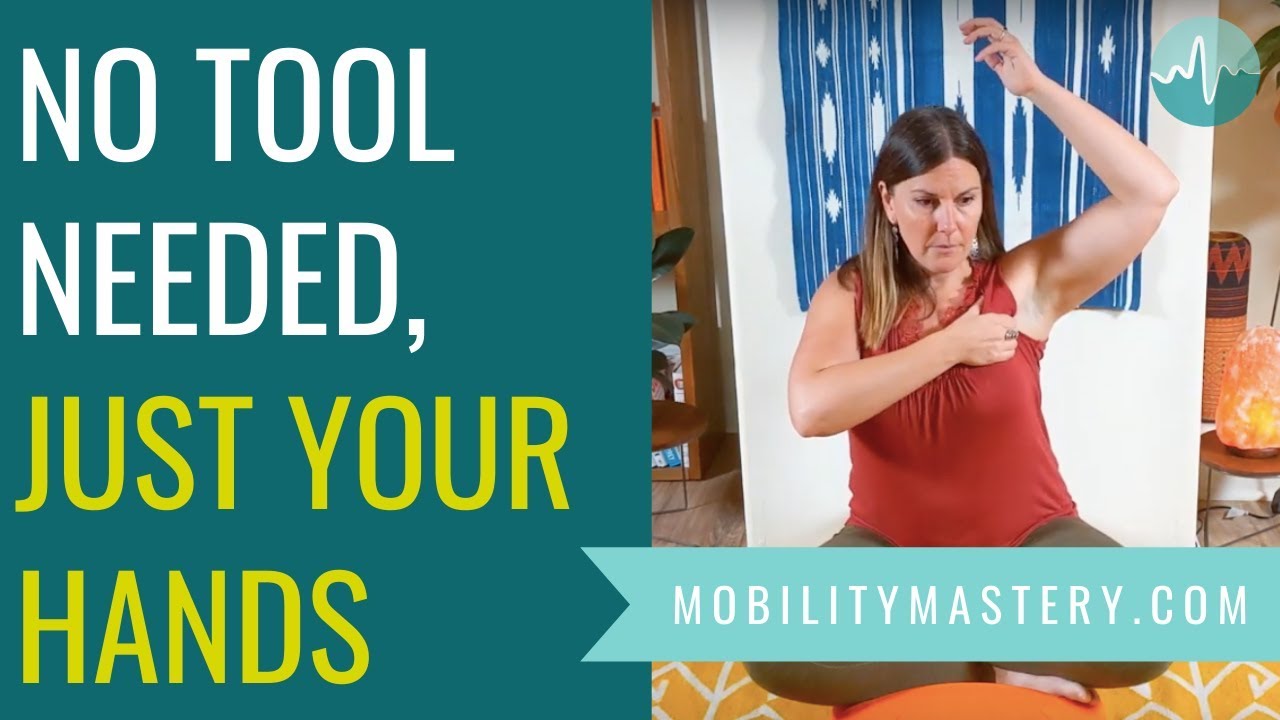
 In this video I’m demoing a technique using ONLY YOUR HANDS to release your chest and armpit area. Specifically, we’re going after the fascia of your pec minor, pec major, maybe some serratus anterior superior and other muscle groups.
What’s important to know about the REGION you’re going after is this:
Your armpit has a ton of lymph nodes. Venous return (deoxygenated blood coming from your arms back to your heart) may be impacted the most in the armpit area, both the anterior and rear armpits. Please check out my lat and rear deltoid technique if you want to do a COMPLETE opening of this area for venous flow that is a perfect compliment to this chest technique.
Reasons you might want to try this technique:
- You have arm or shoulder pain in the soft tissue
- You have elbow, shoulder or neck pain
- You suspect you have poor blood circulation in your upper body
- You want to maximize your detox efficiency (the armpit is FULL of lymph nodes)
- You don't have a foam roller or ball to do the other chest techniques (all you need are your HANDS for this one)
- You have heart issues. I'm no doctor, and this isn't meant to be advice about whatever condition you may be experiencing, but I suspect there is a correlation between fascial restriction in the upper body, and specifically in this one area, and heart issues (maybe even heart attacks....but again, this is just a theory and I'm inviting you to be your own citizen scientist. Please see a doctor if that's what you really need).
- You want to rule this area in or out for tightness, and if it is tight (even if you're not in pain or experiencing any of the above) use this technique to OPTIMIZE.
TIPS to get the BEST result using this technique:
1. Finding the right spot or the right “grab” on this technique may take time. Be patient, and continue “hunting” for the best spot, or the best use of your hand grab of the tissue before thinking this technique isn’t for you.
2. Try using your middle finger to get into the rib and armpit area, towards but underneath your boob (ladies) or underneath the shelf of your chest.
3. Your THUMB is a stabilizing force during this technique. It’s not meant to grab as much as your fingers, it’s simply helping out to stabilize tissue on the opposite side from where the work is being done.
4. Move SLOWLY.
5. Use your whole arm to perform this stretch. Try staying bent at the elbow. Try straightening your arm. Use forward movement (elbow coming in front of you) to “load” the fascia into your armpit area and your fingers, and then slowly stretch it by moving backwards or behind you.
6. There are at least 4-6 inches of tissue you could explore here, depending on your height, build, sex and musculature. Aim to cover the area from just below the crease of your shoulder meeting your armpit all the way towards the bottom of your boob/chest, in your rib area.
7. For each spot you find, spend 30-40 seconds loading and stretching, grabbing and moving.
8. If you get SORE the next day - this is normal. When using a tool such as your own hand, this is bound to happen. While I don’t love it, and normally I advocate NOT getting sore, in this case don’t consider it a bad thing. It’s a less than ideal byproduct of doing this technique, but something I’m totally ok with for the payoff (results).
Give this a try and share your experience in the comments section below! I’d love to hear how this goes for you.


0 Comments